

Working with a recruitment agency effectively starts long before you pick up the phone. The real secret? Treat the process like a strategic partnership. That means doing your homework first: creating a detailed internal brief that defines what success actually looks like, benchmarking the salary properly, and clearly articulating why someone should want to work for you.
This initial groundwork is what turns a recruiter from a simple CV-pusher into an informed, passionate ambassador for your brand.
Laying the Groundwork for a Successful Agency Partnership
Before you even think about engaging an agency, the most important work happens inside your own walls. I’ve seen it countless times: a hiring manager forwards a generic job description and just hopes for the best. This approach almost always leads to a flood of irrelevant CVs and a frustrating, time-sucking process for everyone involved.
To truly set an agency up for success—and get the calibre of candidates you actually want to hire—you need to build a solid foundation first. This isn't just about listing skills on a page. It's about painting a complete, compelling picture of the role, the team, and the opportunity itself.
Go Beyond the Job Description with a Success Profile
A standard job description lists responsibilities and qualifications. A 'success profile', on the other hand, shows what achievement actually looks like in the role. It answers the one question every great candidate is thinking: "What will I have accomplished in my first six months to be considered a fantastic hire?"
To build this, you need to get the hiring manager and a couple of key team members in a room (or on a call) and hash out the specifics:
- 30-60-90 Day Goals: What are the immediate priorities? What specific projects will they own? What key relationships do they absolutely have to build? For example, "Within 30 days, successfully ship their first small feature to production."
- Key Performance Indicators (KPIs): How will you actually measure their performance? For a software developer, this might be about code quality and deployment frequency. For a project manager, it could be hitting project delivery timelines and staying on budget. Be specific: "Maintain a bug rate of less than 2% on all new code."
- Cultural Contribution: How do they need to communicate and collaborate to thrive in your team? Are you a fast-paced, direct-feedback kind of place, or more methodical and consensus-driven? Be honest. An example could be: "Must be comfortable pair programming and participating in no-blame post-mortems."
This level of detail gives a recruiter a real story to tell, shifting the conversation from a boring list of duties to an exciting vision of impact.
The whole process boils down to these essential prep steps: defining the role, benchmarking the offer, and creating a brief that actually sells the opportunity.
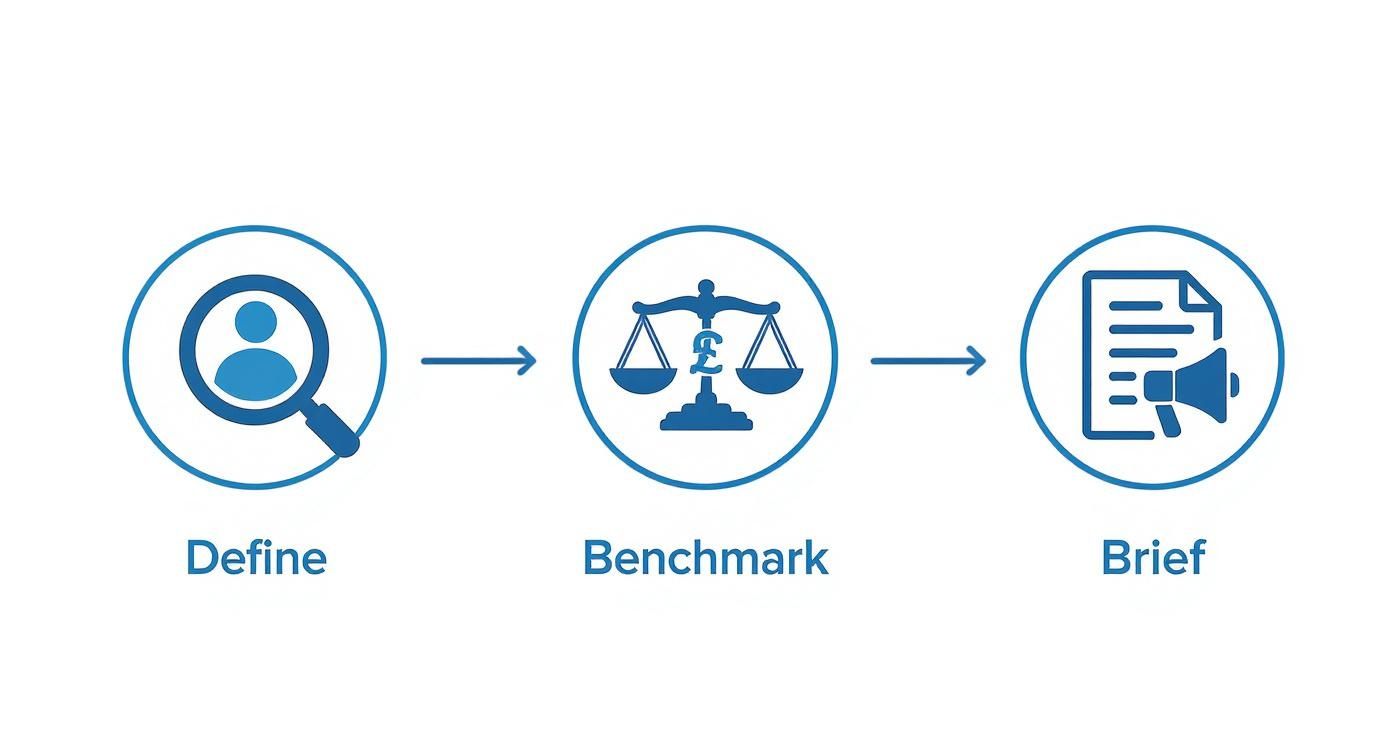
Nail this three-step framework, and by the time you engage an agency, you’ll have a clear, compelling, and realistic proposition in hand.
Benchmark Your Salary to Attract Top Talent
Let's be blunt: in the UK tech market, a non-competitive salary is a non-starter. Before you brief any agency, you absolutely must benchmark your proposed salary against real-time market data. The vague, lazy phrase "competitive salary" just doesn't cut it anymore.
Use free resources like LinkedIn Salary, Glassdoor, or Otta to get a realistic range. For highly specialised or senior roles, it's often worth using paid, more granular data from tools like Pave or Ravio. This homework prevents you from wasting weeks on candidates who are way out of your budget and gives your agency partner confidence that you’re serious.
Your salary band is more than just a number; it's the first signal to the market about how much you value the role. An unrealistic figure undermines your credibility and makes it incredibly difficult for even the best recruiter to attract top-tier talent.
Articulate Your Employer Value Proposition
Finally, you need to arm your recruiter with your Employer Value Proposition (EVP). This is the 'why'. It’s the compelling reason a top performer, who is probably happy and well-paid, should leave their current job to join you. This goes far beyond a bulleted list of benefits.
Your EVP brief should cover things like:
- The Team Dynamic: Who will they be working with day-to-day? What’s the management style of their direct line manager?
- Career Pathways: What does real growth look like in this role? Share an actual example of someone who started in a similar position and has since been promoted.
- Company Culture in Action: Don't just say you're "collaborative." Describe your sprint planning process, your no-blame approach to code reviews, or how you celebrate wins as a team.
When you invest this time upfront, you transform your agency from a simple supplier into a true extension of your talent team. It’s the single most important step in learning how to work with recruitment agencies effectively.
If you need help defining these needs, specialist IT recruitment agencies like APPLY RECRUITING LTD can offer expert guidance.
How to Find and Vet the Right UK Recruitment Agency

Choosing the right recruitment partner in the UK can feel like finding a needle in a haystack. The market is absolutely flooded with agencies, all vying for your attention. This isn't just a number; it's a warning. Without a solid plan, you can easily end up with a partner who over-promises and under-delivers.
The first, and most important, decision you'll make is the engagement model. This choice sets the tone for the entire relationship and dictates the level of service you'll get.
Contingent vs Retained: Which Model Suits You?
The two main ways to engage an agency in the UK are contingent and retained. Getting this wrong can lead to a lot of frustration, so it pays to understand the fundamental difference.
- Contingent Search: This is the classic "no win, no fee" arrangement. You only pay the agency's commission if you actually hire a candidate they've put forward. It's the go-to for many junior to mid-level roles where there's a decent pool of available talent.
- Retained Search: Here, you're paying for a dedicated service. It involves an upfront fee (usually the first of three instalments) to secure an agency's exclusive focus on a critical search. This is the model for senior, highly specialised, or business-critical hires where you need an exhaustive, methodical sweep of the entire market, not just the low-hanging fruit.
A contingent model incentivises speed—agencies are in a race against your internal team and potentially other agencies. A retained model incentivises partnership and quality; the recruiter is a dedicated consultant committed to filling your role.
To see how this plays out, imagine trying to fill a niche Senior DevOps role using three contingent agencies at once. What usually happens? The same handful of top candidates get called by three different recruiters about the same job. It’s a terrible candidate experience and makes your company look disorganised.
Choosing Your Model: Contingent vs Retained Recruitment
This quick-glance comparison should help you decide which agency model best suits your hiring needs, budget, and urgency.
| Feature | Contingent Recruitment | Retained Recruitment |
|---|---|---|
| Payment Structure | Fee paid only on successful placement ("no win, no fee"). | Fee paid in instalments (e.g., at the start, shortlist, and completion). |
| Best For | Junior to mid-level roles, roles with a large talent pool, non-urgent hires. | Senior, niche, or leadership roles; confidential searches; business-critical hires. |
| Agency Focus | Split across multiple clients and roles; prioritises easily "fillable" positions. | Dedicated, exclusive focus on your role until it's filled. |
| Search Process | Tends to focus on active candidates in their database or on job boards. | Proactive and exhaustive headhunting, including passive candidates and market mapping. |
| Relationship | Transactional. The agency is a supplier. | Consultative partnership. The agency acts as an extension of your team. |
| Risk | Lower financial risk, but can result in lower-quality shortlists or no candidates at all. | Higher upfront financial commitment, but a much higher likelihood of a successful hire. |
Ultimately, your choice depends on how critical the role is. For a standard Software Engineer, contingent might be fine. For your first Head of Engineering? A retained search is a much safer bet.
Spotting True Specialists from Generalists
So many agencies slap "tech specialist" on their website, but their real expertise is often wafer-thin. A genuine specialist lives and breathes your world. They understand the difference between Java and JavaScript without needing to Google it, and they can have a proper conversation about your tech stack.
You need to dig deeper than their sales pitch.
- Case Studies & Testimonials: Are they talking about success stories relevant to you? Or are they showing off a Java developer placement when you're hiring for a Scala expert? Look for specific, relatable examples.
- Consultant Profiles: Jump on LinkedIn and check out the consultants you'll actually be working with. Have they consistently placed people in your specific niche, or do they jump between placing accountants one month and developers the next?
- Market Knowledge: Put them on the spot. Ask about recent salary trends for the roles you’re hiring for. Ask who they see as your main competitors for talent. A real specialist will have this information ready to go.
Key Questions to Ask Potential Agency Partners
Once you've got a shortlist, it’s time for an interview. And yes, you should treat it like a proper interview. Your goal is to get past the polished pitch and see how they actually operate.
Here are a few sharp questions to get you started:
- "Walk me through a recent, difficult search you completed for a role like this. What were the biggest hurdles, and how did you get past them?"
- "What does your screening process look like? How do you assess technical skills versus cultural fit before a CV even lands in my inbox?"
- "How do you handle Right to Work in the UK checks? Can you walk me through your compliance process?"
- "Could you provide two recent client references for tech roles you’ve filled in the last six months?"
Their answers (or lack thereof) will tell you everything you need to know about their experience, their commitment to quality, and whether they understand essential UK compliance. Exploring what a full suite of specialist recruitment services looks like can also give you a benchmark for what to expect.
Finally, a quick but important check: see if they're members of a professional body like the Recruitment & Employment Confederation (REC). It’s not a guarantee of brilliance, but it shows they’re committed to ethical standards. It's a simple quality filter that helps weed out the cowboys.
Crafting a Brief That Gets You Better Candidates
The quality of the candidates you see is a direct reflection of the quality of your brief. It’s that simple. If you just forward a generic, copy-pasted job description, you're signing up for a deluge of irrelevant CVs. Think of your brief as the agency's north star; the clearer and more detailed it is, the more precisely they can navigate the talent market for you.
A powerful brief goes way beyond a checklist of technical skills. It’s about sharing the nuance—the unwritten rules of what it takes to succeed in your team. Your real goal here is to arm the recruiter with enough insight that they become a genuine extension of your hiring team, filtering candidates not just on keywords but on whether they'll actually fit.
Moving Beyond the Standard Job Description
The typical job spec is a decent starting point, but it's really just a list of duties and qualifications. To attract better candidates, you need to add the layers of context that bring the role, and your company, to life. This is where you explain the human element that a formal document always misses.
Start by thinking about the intangible but critical stuff:
- The Team Dynamic: Is the team super collaborative, with daily stand-ups and constant pairing? Or is it more of a "deep work" environment where people are left to get on with it? Are they a boisterous, sociable group or more heads-down and analytical? These details matter.
- The Manager's Style: How does the hiring manager actually lead? Do they want detailed daily updates or are they happy with a high-level summary at the end of the week? Are they a hands-on mentor or someone who gives their team total autonomy?
- Success in Six Months: What does a brilliant hire look like after 180 days? Be specific. Have they shipped a key feature, onboarded three new clients, or started refactoring a legacy process? Paint a picture of what "good" looks like.
This is the information that allows a recruiter to have far more meaningful conversations on your behalf. They can screen for people who won’t just do the job, but will genuinely thrive in your specific environment.
Be Honest About the Challenges
Every role has its tough parts. Maybe it involves wrestling with a clunky legacy codebase, dealing with demanding stakeholders, or navigating a tricky period of organisational change. It’s tempting to gloss over these points, but being upfront is a massive strategic advantage.
When you're transparent about the challenges, you empower your agency to:
- Screen for Resilience: They can ask targeted questions about how candidates have handled similar tough situations before.
- Manage Expectations: Candidates go into the process with their eyes wide open, which dramatically reduces the risk of last-minute offer declines or people leaving after a few months.
- Build Credibility: A bit of honesty builds trust with both the recruiter and the candidates. It positions your company as a mature, straightforward place to work.
Don't sell a perfect dream. Sell a real, rewarding challenge. The best candidates aren't looking for an easy ride; they're looking for an opportunity to make a tangible impact, and that often means solving difficult problems.
The Power of a Live Kick-Off Call
A written brief is essential, but it should never be the final word. The single most effective thing you can do to align with your agency is to schedule a 30-minute kick-off call. This isn't just a box-ticking exercise; it's a critical strategy session.
Treat this call as a two-way intelligence-gathering exercise. It’s your chance to convey the passion and nuance that text can’t capture, and it’s the recruiter’s chance to probe, question, and challenge your assumptions. A great recruiter will ask tough questions about salary benchmarks, team culture, and why the last person in the role left. Welcome this—it shows they’re actually thinking about the search.
This one conversation turns a transactional document into a shared mission. The recruiter walks away with not just a spec sheet, but a genuine feel for the role, the manager, and the company. And that’s the difference between an agency that just sends CVs and a partner that finds you your next great hire.
Getting the Most Out of Your Agency Partnership

Signing the contract isn't the finish line; it’s the starting gun. A successful outcome hinges on nurturing a proper partnership. The best agencies don’t want to be kept at arm’s length; they want to be treated as an extension of your team, armed with the insight they need to genuinely represent you in the market.
To get real value from your investment, you have to actively manage the relationship. IBISWorld offers more detailed insights on the UK employment agency market.
Set a Clear Communication Rhythm
Vague, sporadic communication is the fastest way to derail a search. Right from the kick-off call, you need to agree on a communication cadence that works for both of you. This isn’t about micromanagement; it’s about creating a predictable, efficient flow of information.
Agree on a weekly check-in call or a standardised email update. This should cover key metrics and, just as importantly, qualitative feedback.
- Candidates approached (Sourcing effectiveness)
- Screenings completed (Pipeline health)
- CVs submitted for review (Submission rate)
- Interviews arranged (CV-to-interview ratio)
- Offers made (Interview-to-offer ratio)
- Reasons for candidate withdrawal (salary, role, process)
A simple structure like this kills the need for those "any updates?" emails and gives you a clear, honest view of the pipeline's health. A shared Trello board or a simple Google Sheet can work wonders here, providing a single source of truth for all activity.
The Art of Giving Great Feedback
Generic feedback like "not the right fit" is completely useless. To help your recruiter zero in on what you actually need, you have to provide specific, constructive criticism on the CVs they send. This is non-negotiable for anyone serious about how to work with recruitment agencies effectively.
Think of it as calibrating their search. The more precise your input, the better their output becomes.
Vague feedback leads to vague candidates. Specific feedback is a masterclass for your recruiter, teaching them the nuances of your culture and needs. It’s the difference between them guessing and them knowing.
Instead of just rejecting a candidate, explain why.
Instead of: "Not enough experience."
Try: "Their experience is all in massive corporate environments. We need someone who has scaled a product from the ground up in a proper startup setting."
Instead of: "Culture fit doesn't feel right."
Try: "This candidate's profile reads like a pure individual contributor. We need a natural collaborator who lives for pair programming and team brainstorming."
This level of detail empowers your recruiter. They can immediately adjust their sourcing strategy and have far more targeted conversations with potential candidates, screening out similar profiles before they ever reach your inbox. It saves everyone a huge amount of time.
Navigating UK Compliance Responsibilities
While the agency does a lot of the heavy lifting, the ultimate responsibility for compliance still sits with you, the employer. A major one in the UK is completing proper Right to Work checks.
Don't just assume your agency has it covered. Ask them to confirm their process for verifying a candidate's eligibility to work in the UK. They must be following the official Home Office guidelines. This is a critical step in protecting your business from some hefty civil penalties. You can review the official guidance on Right to Work checks for employers on GOV.UK.
Beyond that, it’s wise to clarify who handles what at each stage. For instance, if you're hiring contractors, you need to be crystal clear on how IR35 status determinations will be handled. The responsibility often sits with the end client (that’s you), so make sure this is discussed and documented from day one. For practical advice on employment status and rights, the Advisory, Conciliation and Arbitration Service (ACAS) is an excellent resource.
By setting a clear rhythm, providing sharp feedback, and staying aligned on compliance, you transform the relationship from a simple transaction into a powerful strategic partnership. This collaborative approach is what truly unlocks an agency's full potential.
Disclaimer: This article provides general guidance and is not a substitute for professional legal or financial advice. Always consult with a qualified expert for your specific circumstances.
Getting The Commercials and Contracts Right

You’ve found your perfect candidate. The hard part is over, right? Not quite.
Once the offer is accepted, the focus has to shift to the commercials and the logistics. This is where a clear, fair contract and a watertight post-offer process become non-negotiable. Get this bit right, and you protect your investment and ensure a smooth start for your new hire. Mess it up, and all that hard work can unravel.
Don't just skim and sign the agency's terms of business. Take the time to properly understand what you're agreeing to—it’s the financial and legal framework for the entire relationship.
Decoding Agency Fees and Commercial Terms
In the UK, the standard fee model is a percentage of the candidate’s first-year guaranteed salary. You can expect this to be anywhere from 15% to 25%, creeping up to 30% or more for very niche or senior leadership roles. But that’s not your only option.
If you’re hiring for multiple roles or a big project, a fixed-fee or retained model can offer much better value. A fixed fee gives you budget certainty, which is a lifesaver for scale-ups managing cash flow. It’s also a powerful bargaining chip when you’re committing to a significant volume of work with one partner.
But the most critical part of any agency contract? The rebate or free replacement clause.
Think of the rebate clause as your insurance policy. It spells out exactly what happens if a candidate leaves within their first few months. Never, ever accept terms without a clear, fair rebate period. It’s what holds the agency accountable for the long-term quality of their placement.
A typical UK rebate structure is a sliding scale. It usually looks something like this:
- Leaves in weeks 1-4: 100% refund or a free replacement.
- Leaves in weeks 5-8: 50% refund.
- Leaves in weeks 9-12: 25% refund.
You should always push for a minimum of a 12-week rebate period. If an agency is truly confident in its screening and the quality of the candidates it puts forward, they should have no problem agreeing to this.
Nailing the Post-Offer Process
The moment a candidate accepts your offer, a new and delicate phase begins. A sloppy, disorganised post-offer process creates anxiety and is a common reason for candidates to get cold feet and drop out, even at this late stage. To stop this from happening, you need to establish crystal-clear ownership between your team and the agency.
Decide upfront who is responsible for what. Ambiguity here is your enemy.
Key Ownership Areas to Define:
- Reference Checks: Will the agency handle these, or is it an internal HR job? If the agency is doing them, ask to see their standard questions to make sure they’re asking what you need to know.
- Right to Work Verification: The agency should have done an initial check, but the legal responsibility ultimately lies with you, the employer. Make sure you follow the latest Home Office guidance on GOV.UK to get the final verification right.
- Start Date Communication: Nominate a single point of contact—usually the hiring manager or someone from HR—to finalise and communicate the start date. This stops crossed wires and ensures the candidate gets one clear, consistent message.
- Onboarding Support: A great agency partner stays involved. They should be checking in with the candidate during their notice period, keeping them warm and engaged, and helping to head off any counter-offers from their current employer.
This kind of structured approach ensures nothing falls through the cracks. It keeps the momentum going and provides a professional, reassuring experience for your new hire, all the way from offer to their first day. It’s this post-hire phase that often cements the real long-term value of a great agency relationship.
Of course, the hiring landscape is always shifting. Many companies are now exploring more flexible talent solutions, and you can learn more about why more companies are turning to IT contractors in our detailed guide.
Disclaimer: This article provides general guidance and is not a substitute for professional legal or financial advice. Always consult with a qualified expert for your specific circumstances.
Got Questions? We've Got Answers
Working with recruitment agencies, especially in the fast-paced UK tech scene, can throw up a lot of questions. We get it. Here are some of the most common queries we hear from hiring managers, with straight-talking answers based on what actually works.
Should I Work with Multiple Agencies or Just One?
This is a classic one. For most permanent roles, especially the tricky ones needing specific skills, giving exclusivity to a single, specialist agency nearly always wins.
When you give a recruiter exclusivity, you're not just a job on a list; you're a priority. They become a genuine partner, investing the time to really get under the skin of your company culture. It gives them the confidence to headhunt passive candidates—the ones not actively looking—knowing their hard work won't be for nothing.
On the other hand, throwing a role out to multiple contingent agencies often creates a mad dash. It becomes a race to fling CVs into your inbox, and the first things to get sacrificed are quality and proper screening. It can also make you look a bit chaotic to candidates, who end up being called by three different people about the same job. Not a great look for your employer brand.
What's a Standard Recruitment Agency Fee in the UK?
You can typically expect recruitment fees in the UK to fall somewhere between 15% and 25% of the candidate’s first-year annual salary.
But that’s a big range, and a few things will push the number up or down:
- Seniority: A junior dev role might sit at the lower end, around 15-18%. A Head of Engineering? That’s more likely to be 25% or even higher.
- Scarcity: If you're after someone with niche skills in, say, machine learning or a specific corner of cybersecurity, the fee will reflect how hard they are to find.
- The Model: A retained search, where you pay a portion of the fee upfront, commands a higher rate—often 25-30%. That’s because it’s a much more intensive, dedicated search process.
The most important thing? Make sure the fee structure and exactly what counts as "salary" (like guaranteed bonuses) are nailed down in your terms before any work starts. No surprises later.
How Can I Make Sure an Agency Really Gets Our Culture?
You have to go way beyond the job spec. Culture isn’t about a list of perks; it's about the unwritten rules, the inside jokes, and how the team interacts every day. It's your job to bring that to life.
Sure, send them your Employer Value Proposition (EVP) or any internal culture decks. But what really works? Invite the lead recruiter to the office for a quick tour. Or even better, get them on a short, informal video call with one or two people from the team they'll be hiring for. The more they can soak up the real environment, the better they'll be at spotting a genuine cultural fit, not just someone who ticks the keyword boxes.
A great recruiter doesn't just sell a job; they sell the experience of working in your team. Give them the authentic stories and insights they need to have those compelling, human conversations on your behalf.
What Happens If a New Hire Leaves After a Few Weeks?
This is exactly what the "rebate" or "free replacement" clause in your contract is designed for. Think of it as your safety net.
Most agencies in the UK offer a rebate on a sliding scale if a candidate leaves within a set period—usually the first 12 weeks. It might look something like this: a 100% refund if they leave in the first four weeks, dropping to 50% between weeks five and eight, and so on. Some agencies offer a free replacement instead.
This is a non-negotiable part of your contract. Always push for at least a 12-week protection period and be absolutely clear on the terms before you sign anything. It’s what holds the agency accountable for finding you a lasting, high-quality hire, not just a short-term fix.
Disclaimer: This article provides general guidance and is not a substitute for professional legal or financial advice. Always consult with a qualified expert for your specific circumstances.
Struggling to find the right IT talent in a crowded market? APPLY RECRUITING LTD is a specialist UK-based agency that connects you with exceptional tech professionals who aren't just looking for a job, but the right challenge. We go beyond the job boards to find the talent you need.